How Music Helps Children's Brain Development
Can music make children smarter and more confident? Discover how music lessons support brain development, focus, communication skills, emotional growth.
LEARN MUSIC ONLINE
Talkingbees
6/4/2026
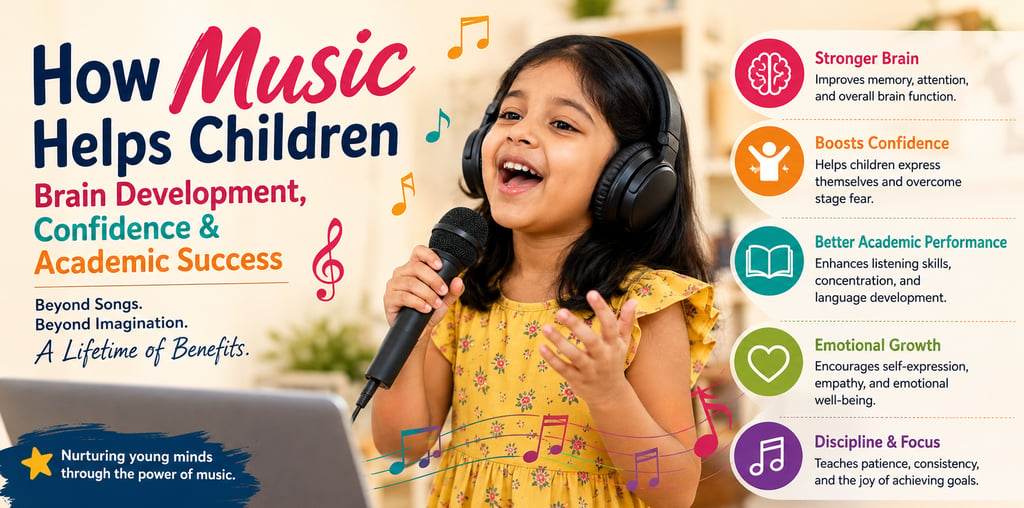
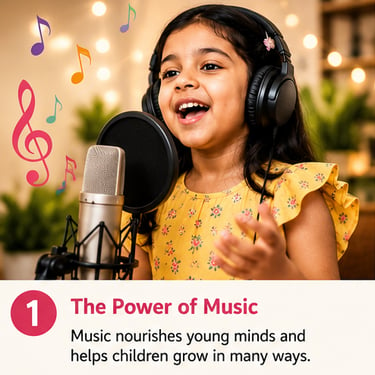
Child singing during an online music lesson that builds confidence, communication skills, and creativity
Most parents have seen it happen.
A child can spend twenty minutes trying to memorize a song and remain completely engaged.
The same child may struggle to spend five minutes memorizing a paragraph from a textbook.
Why?
The answer reveals something fascinating about how children learn.
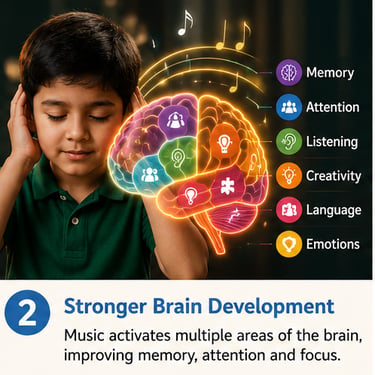
Music occupies a unique place in human development. It is not simply entertainment. It is not merely a hobby. It is one of the few activities that simultaneously engages memory, attention, language, emotion, listening skills, pattern recognition, creativity, and self-expression.
That combination is rare.
And it helps explain why researchers, educators, psychologists, and parents continue to view music as one of the most valuable learning experiences for children.
When a child learns music, something much bigger is happening than learning songs.
They are learning how to learn.
Why Music Is Different From Other Activities
Children today have countless activities available to them.
Sports develop physical coordination.
Reading develops literacy.
Art develops creativity.
Technology develops digital skills.
Each has its place.
Music is different because it activates multiple systems of the brain at the same time.
A child learning a song must:
Listen carefully
Recognize pitch
Follow rhythm
Remember lyrics
Control breathing
Monitor their own performance
Express emotion
Adjust mistakes
Few childhood activities require this level of simultaneous mental engagement.
The result is a learning experience that feels enjoyable while exercising many important cognitive abilities.
Parents often focus on the visible outcome:
"My child learned a song."
The invisible outcome is often far more important:
"My child strengthened memory, attention, listening, and confidence."
The Brain Loves Music
Think about how much information exists inside a single song.
There are words.
There are melodies.
There are rhythmic patterns.
There are emotional cues.
There are timing adjustments.
There are breathing patterns.
The brain must process all of these together.
Unlike passive entertainment, music demands participation.
Children must actively listen, predict, remember, and respond.
This is one reason music has fascinated neuroscientists for decades.
Music engages both analytical and creative systems simultaneously.
The child experiences joy.
The brain experiences training.
And that combination is incredibly powerful.
Why Singing Helps Children Communicate Better
Many parents enroll children in music lessons hoping they will sing better.
Often they notice something else first.
Their child begins communicating more confidently.
This makes sense.
Singing requires children to use their voices intentionally.
They learn:
Clear pronunciation
Breath control
Voice projection
Expression
Timing
Over time, children become more comfortable being heard.
That confidence often extends beyond music lessons.
Teachers notice it.
Parents notice it.
Friends notice it.
The child who once hesitated to speak begins participating more actively.
Not because music magically changes personality.
Because music provides repeated opportunities to practice communication in a supportive environment.
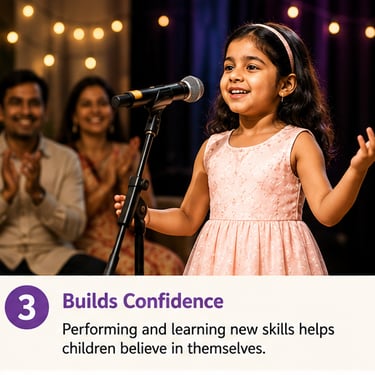
Confidence Is Built, Not Given
Parents often want confident children.
The challenge is that confidence cannot simply be taught.
Confidence develops through experience.
Children become confident when they repeatedly encounter challenges and overcome them.
Music creates this process naturally.
At first, a new song feels difficult.
The melody feels unfamiliar.
The rhythm feels confusing
The child makes mistakes.
Then something important happens.
They practice.
They improve.
They succeed.
That experience sends a powerful message:
"I can learn difficult things."
That belief becomes the foundation of genuine confidence.
Not confidence based on praise.
Confidence based on evidence.
Music Strengthens Listening Skills
Listening is one of the most important skills in education.
Yet it is often overlooked.
Children who learn music spend significant time developing active listening abilities.
They learn to hear:
Pitch differences
Rhythmic variations
Timing changes
Teacher feedback
Musical patterns
These skills transfer beyond music.
Strong listeners often become stronger learners.
They absorb information more effectively.
They follow instructions more accurately.
They engage more deeply in conversations.
In an increasingly distracted world, this may be one of music's greatest gifts.
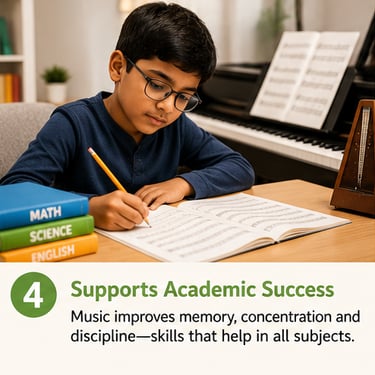
Music and Academic Performance
Music does not replace academic study.
A child still needs to read, write, and learn mathematics.
However, music develops several mental abilities that support academic success.
These include:
Memory
Children memorize lyrics, melodies, and performance details.
Attention
Music requires sustained focus.
Pattern Recognition
Rhythm and melody are built on patterns.
Discipline
Progress requires regular practice.
Language Processing
Songs expose children to vocabulary, pronunciation, and linguistic structure.
These abilities contribute to learning across multiple subjects.
This helps explain why many educators view music as an important complement to academic education.
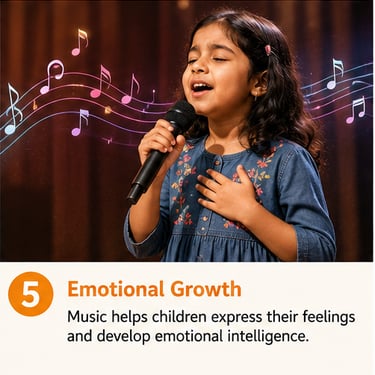
Emotional Development Through Music
Children experience emotions intensely.
Yet they do not always have the vocabulary to express them.
Music provides an outlet.
A joyful song communicates happiness.
A devotional song communicates gratitude.
A gentle melody communicates calmness.
A powerful performance communicates confidence.
Through music, children learn to recognize and express emotions in healthy ways.
This contributes to emotional intelligence, a skill that influences relationships, resilience, and long-term well-being.
Why Ages 4–10 Matter So Much
The early years are a remarkable period of development.
Children between four and ten are:
Building communication skills
Developing attention spans
Forming habits
Strengthening memory
Learning social skills
Discovering interests
Music fits naturally into this stage.
Children learn through repetition, play, imitation, and creativity.
Music combines all four.
This is why many music educators encourage families to begin training early.
The goal is not to create child prodigies.
The goal is to create confident, capable learners.
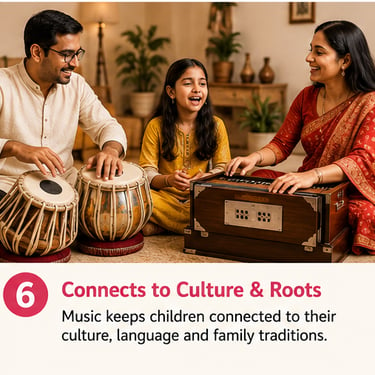
Music Connects Children to Culture and Identity
Music is more than skill development.
It is also connection.
Through songs, children connect with:
Family traditions
Language
Heritage
Community
History
Whether learning Bengali songs, Hindi songs, bhajans, folk songs, or classical music, children gain access to cultural experiences that textbooks cannot fully provide.
Music becomes a bridge between generations.
The Real Value of Music
The greatest benefit of music is not producing professional musicians.
Most children will choose different careers.
That is perfectly fine.
The value of music lies in the person it helps build.
A child who learns to focus.
A child who learns to listen.
A child who learns patience.
A child who learns discipline.
A child who learns self-expression.
A child who develops confidence.
These qualities remain long after individual songs have been forgotten.
Music is not simply an extracurricular activity.
It is an investment in human development.
And that is why, generation after generation, music remains one of the most meaningful gifts parents can give their children.